In the heart of the Gran Chaco Americano, Argentina, where the forest holds ancient silences and the land teaches without words, Oichena is born: a project that brings together ancestral textile art and the affirmation of the feminine as a territory of living memory.
Catalina Carbajo, a lawyer and communications specialist, has worked for more than five years alongside Indigenous women in northern Argentina. Her professional path intertwines with a more intimate and transformative experience. “I come from law and strategy, but also from the territory. From the forest, from the shared silence while spinning, from the learning that is not in books but in the hands,” she explains.
From this meeting between technical training and ancestral wisdom, Oichena emerged. “It is born from that intersection: between professional management and ancestral memory.” Above all, it is born from listening: from understanding that weaving is not an isolated technique, but a way of being in the world.
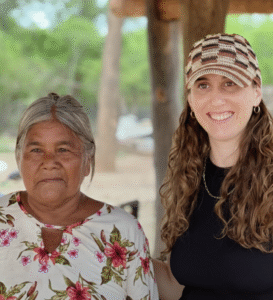
Catalina Carbajo, founder of Oichena (on the right)
Weaving as sacred memory
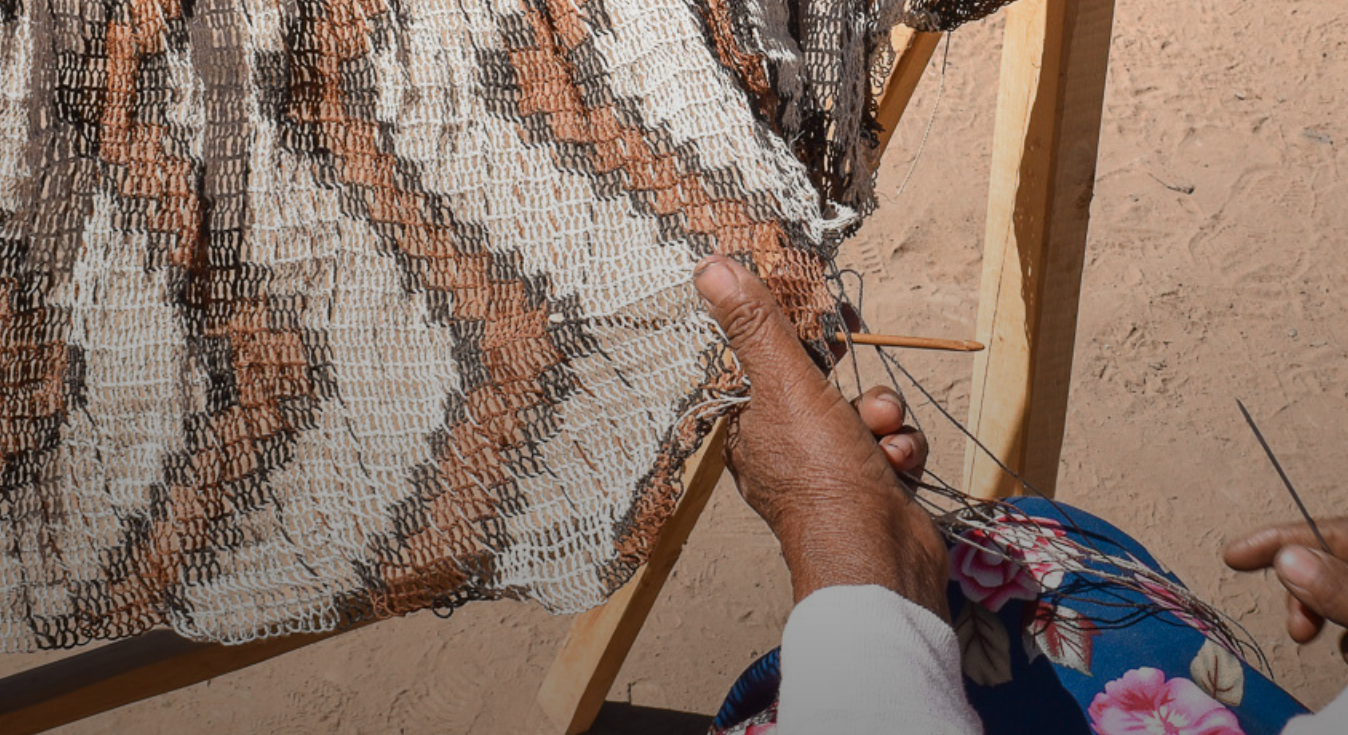
Oichena works alongside Wichí women and creates pieces from chaguar fiber, a plant native to the Chaco forest. In the Wichí language, “Oichena” means “I am here.” “It is an affirmation of presence, identity, and cultural existence,” says Catalina. It is the voice of women who do not belong to the past, but to a present that breathes and creates.
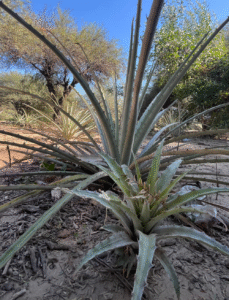
Each piece is made entirely by hand: harvesting the plant, peeling, drying, spinning, and natural dyeing all follow the rhythm of the forest. “It is a process that cannot be rushed.” Within this slowness lives something sacred: respect for nature’s cycles and for the time each gesture requires.
“Weaving is language, it is archive, it is identity.”
It is not merely about design or aesthetics. Every knot holds memory; every fiber carries a story passed from mother to daughter. “It is the women who teach the girls to spin, who transform plant fiber into language.”
Honoring this gesture means recognizing them as creators and guardians of knowledge that has survived because of them. Textile work thus becomes a space of feminine continuity: a weave where past and present meet without rupture.
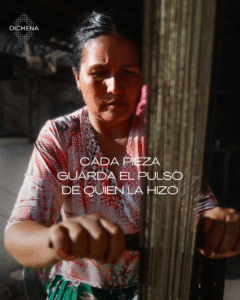
The pieces—bags, shawls, belts, cloths, and contemporary objects—dialogue with today’s world without losing their roots. No two are alike. Each carries the imprint of the woman who wove it and the pulse of the territory from which it comes. To wear them is to carry more than an object: it is to carry a fragment of woven forest.
Growing without losing the root
In a fast-paced world, choosing a handmade piece is a conscious act. “To wear an ancestral piece is to carry a story; it is to take an ethical stance toward consumption.”
Oichena does not deny the economic dimension—fair recognition and remuneration of the work are essential—but it places it within a broader framework: respect for life, for time, and for the dignity of those who create.
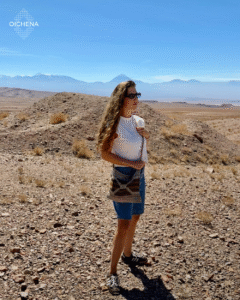
International expansion toward Europe, the United States, Mexico, and Australia forms part of the project’s next steps. Yet growth is not conceived merely as entering new markets, but as expanding a symbolic space.
“Our horizon is not only to grow as a brand. It is to expand the symbolic space of Indigenous textile art in the contemporary world.”
Each step forward must translate into greater autonomy for Wichí women and genuine recognition of their art as living heritage.
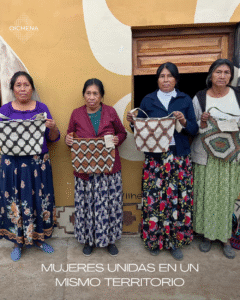
Ultimately, Oichena does more than commercialize textile pieces: it sustains a presence. A serene and steady affirmation of the ancestral feminine that, through the hands that spin and weave, continues to say: I am here.
Text : Anne-Sophie Castro
Photos : Oichena