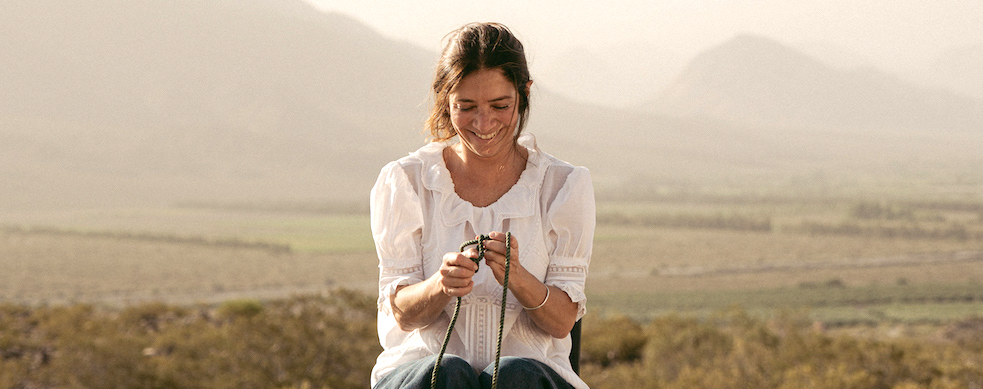
Magdalena López Frugoni was born in the province of Mendoza, Argentina, where the Andes mountain range reaches its greatest majesty and height. A textile artist, she maintains a deep connection to the mountains, having spent much of her life in the snow through skiing. This early relationship shaped her way of perceiving landscape, effort, silence, and the bond with territory—dimensions that remain essential to her identity today.
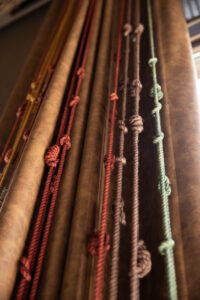
Through the quipu—an ancestral Andean system of cords and knots used by the Incas to record information without alphabetic writing, according to the form, color, and position of the knots—Magdalena López Frugoni translates the invisible.
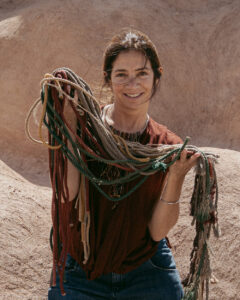
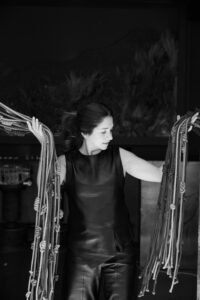
Magdalena López Frugoni, Founder of Quipu Lab.
How did you first encounter the quipus, and what initially drew you to them?
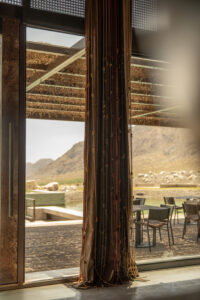
My first encounter with the quipus emerged from a project developed for an architecture and interior design studio, as part of a commission for a winery deeply connected to its territory and Indigenous roots. Within that context, the language of the quipu appeared naturally as part of the spatial concept, and I found in it a way to materialize that symbolic universe. It was a revealing experience.
From that first moment of fascination, I decided to further explore the history of the quipu—its function and its meaning. This path also led me to understand and admire the Andean worldview. Inspired by this cultural legacy, I felt the need to bring visibility to this ancestral form of expression.
What drew me most strongly was its power as a non-written language: volume as a carrier of meaning, memory, and connection—something that is transmitted beyond words. It allowed me to focus my practice on a material and symbolic dimension.
What is Quipu Lab, and why did you feel the need to create it?
Quipu Lab was born as a deeply personal project. Although I hold a degree in Business Administration and worked for many years in other industries, I always carried within me a strong aesthetic sensibility—a particular way of inhabiting spaces, of dressing, and of relating to materiality.
Creating this brand was, in a way, a return to an early desire that had long been postponed: to devote myself to the creative, the sensitive, and the material as a form of thinking. I felt the need to build a space of my own where I could integrate territory, art, memory, and lifestyle in a way that was honest and coherent with my path, my ideas, and my impulse to create with meaning.
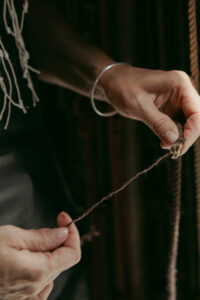
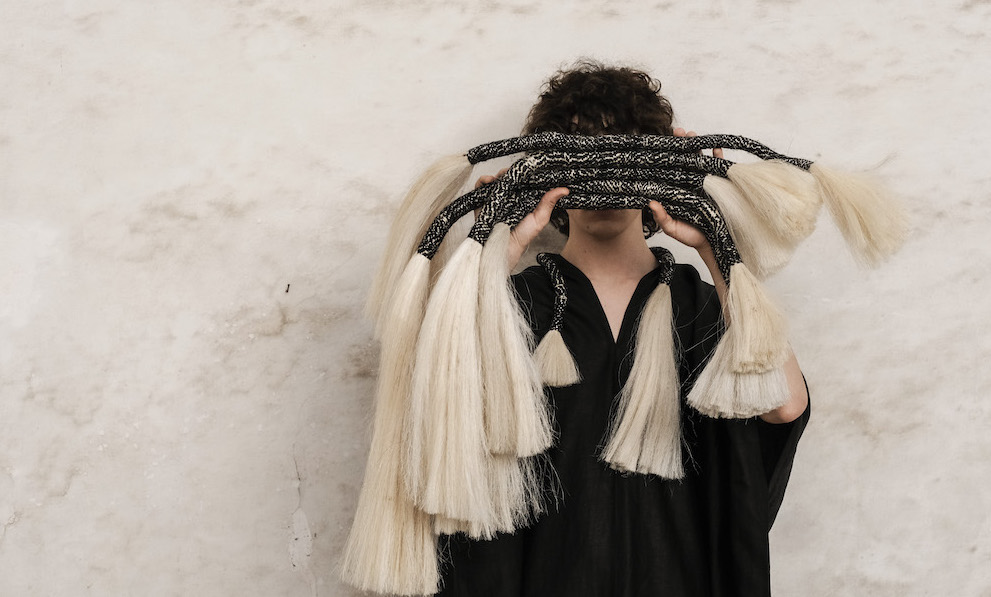
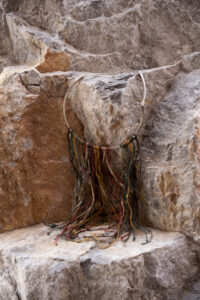
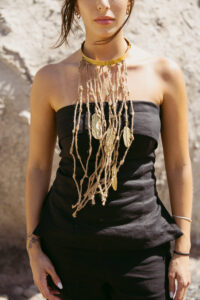
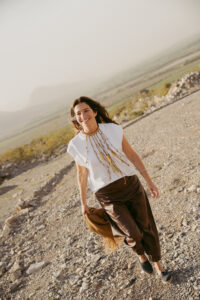
From my studio, I develop both spatial interventions and collections of wearable pieces based on the language of the quipu. I work with ancestral materials and techniques to create visual and poetic works, in which the knot is a central and constant element: each piece contains a knot made using the same technique, as a foundational and symbolic gesture.
Quipu Lab provides the framework that allows me to reinterpret the quipu through a contemporary lens, transforming knots into visual signs that evoke storytelling, connection, and collective memory—without attempting to decipher or intervene in its original language.
What relationship do you see between quipus and the transmission of memory?
For me, the quipu is a way of bringing ancestral memories into the present—memories that still have something to tell us. We live in a time that constantly invites us to let go, and I believe it is essential to find a balance: knowing what to release and what to hold.
There are values, attitudes, and inherited memories—familial, cultural, and ancestral—that form part of our identity and deserve to be cared for and honored. In my work, the quipu becomes this gesture of holding: a living memory that is activated in the present and transmitted forward.
What place does the ancestral feminine occupy in your work?
The ancestral feminine occupies a profound place in my work, just as it does in the lives of all women, even if it is not always consciously acknowledged. A large part of who I am has come to me through the women of my lineage.
My mother and my grandmothers carried an elegance and a refined attention to detail—not so much through manual making, but through a way of seeing the world and relating to others. This feminine presence, transmitted through education and example, appears in my work not as a technique, but as a sensitivity and an aesthetic sense that runs through my entire practice.
What have quipus taught you about time, waiting, and care?
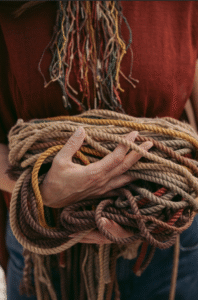
Quipus taught me that time is not only the moment of the knot. Before tying, there is a long and silent process: organizing the cords, untangling the threads, dyeing them, and untangling them again. Often, preparing the fiber takes more time than making the knot itself.
This process taught me patience, care, and presence. Each knot requires its own time, its form, and its place. It cannot be rushed.
I find in this a deep analogy with life. What we are and what we live is not an isolated moment, but the result of what we have been creating over time: what we think, what we feel, what we say, and how we act. Just as in the quipu the knot is the visible result of a silent process, life is also built from multiple layers of time, patience, care, and presence. Nothing can be forced; everything requires its own rhythm, its form, and its space.
How do your works dialogue with the women and forms of knowledge that came before you?
They dialogue in a subtle, non-literal way. In my family, I don’t recall seeing women weaving, but I do remember women with a very strong aesthetic sensitivity: the way they chose flowers, objects, clothing, colors. A gaze trained to find grace in the everyday.
That kind of knowledge is not always transmitted as technique, but as vision. And it is from this place that my works dialogue with those women: through aesthetic sense, care, attention to detail, and a way of presenting oneself to the world.
What importance does the gesture of knotting by hand have in your creative process?
For me, my hands in each work are the sum of many hands. Other hands from the past inhabit them. Each piece is accumulated time, technique, and sensitivity.
When I work, for example, with chaguar threads, I know that before me were the hands of the women of the Wichi community: those who entered the forest, harvested the plant, worked it with natural dyes, and spun it.
My hands—and the hands of those who prepared these threads—are not neutral; they carry a soul. That is why, when I finally tie the knot, I feel that the gesture gathers all that prior energy: a continuity of souls, knowledge, and meaning made present.
This way of working also extends to the collaborations I undertake with other craftspeople and artists. In many projects, I dialogue with goldsmiths, artisans, weavers, ceramists, and artists with extensive experience. It is not about adding disciplines decoratively, but about creating intersections where each material and each hand contributes depth, identity, and value to the final work.
What do you hope is activated in someone encountering your work for the first time?
Above all, I hope a pause is activated—a moment of stillness and attentive perception. I am not seeking an immediate reading or a closed interpretation, but rather a willingness to feel before understanding.
I want the work to awaken curiosity and stimulate imagination: that those who encounter it want to know what a quipu is, where it comes from, what the knots mean. But also that they allow themselves to imagine their own meanings, to assign personal interpretations beyond my own.
There is also a dimension of play that matters greatly to me: following the paths of the threads with the eyes, finding the knots, getting lost and finding oneself again within the weave. That the work is explored rather than decoded. And that it awakens the desire to touch. This is why I speak of a sensory experience: the work is not only seen, it is perceived with the body. In that act of looking, touching, and questioning, memory is activated and made present.

Today, what memory or question are you seeking to hold or transmit?
Today, I am interested in holding the question of what cannot always be expressed through words. There are experiences, emotions, and memories that we often do not know how—or do not want—to articulate verbally.
In this sense, the knot appears to me as a silent language. Knotting is a way of bringing into matter what lives within: an intention, an emotional charge. It is a way of expressing it without explaining it, and also of releasing it.
Although the knot is often associated with the idea of holding, uniting, or binding, for me it is also a way of letting go. When I tie a knot, I leave something there: a memory, a tension, a meaning. And in that gesture, there is relief, meditation, and transformation.
At its core, this is the question that accompanies me today: which memories we choose to keep, which we are ready to release, and how each of us finds our own way—silent or otherwise—of doing so.
Words : Magdalena López Frugoni / Anne-Sophie Castro
Translated from Spanish by IA and edited by Anne-Sophie Castro.
Photos : Santiago Mañanet @santimamanet